West Highland White Terrier - History
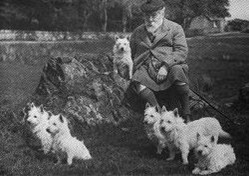 The West Highland White Terrier, commonly referred to as "Westie", is a member of the Terrier Group that derives its origins in the Scottish highlands. Terriers performed specific tasks and were never kept as pet dogs. They were used for protection against predators as well as hunters for fox, rabbits, otters, badgers, and other terrestrial animals. Terriers derive their names from geographical regions or estates from where they originate. In first attempts at selective breeding, rather brutal methods were used. Historic sources say that in order to test terrier's gameness, the owner would drop a young dog into a barrel with a badger. The terrier would be considered fit for further breeding if it managed to survive.
According to a credible historic account of the genesis of the West Highland White Terrier, the breed's origins are linked to Colonel E.D. Malcolm who owned an estate in Argyllshire in Scotland. The Colonel would take his favourite Cairn Terrier along when hunting. The Carin Terrier is a wheaten or brown-haired dog, which is effective as camouflage. Unfortunately, this characteristic proved to be pernicious on that particular day, as the Colonel accidentally shot his dog dead instead of a fox. In order to prevent such accidents from happening, the Colonel decided to breed only white terriers from now on. However, white terriers would occur only very rarely due to the widespread superstition that they were useless for hunting. The Colonel changed the common outlook on usefulness of white-coloured dogs and so a new distinct breed of Westie was developed.
Long time ago, the Westie was known under the names of the Roseneath Terrier and the Poltalloch Terrier. In 1908, the breed was registered by the American Kennel Club under the name of the Roseneath Terrier, which was changed, however, on May 31st 1909 into the West Highland White Terrier.
West Highland White Terrier - Standard
FCI Standard nr 85
F.C.I. Classification:
Group 3 - Terriers, Section 2 - Small sized Terriers, Without working trial
General Appearance:
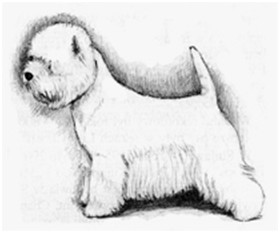
Strongly built, deep in chest and back ribs, level back and powerful quarters on muscular legs and exhibiting in a marked degree a great combination of strength and activity.
Temperament:
Small, active, game, hardly, possessed of no small amount of self-esteem with a varminty appearance. Alert, gay, courageous, self-reliant but friendly.
Head:
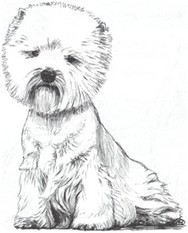
Distance from occiput to eyes slightly greater than length of foreface. Head thickly coated with hair and carried at right angle or less to axis of neck. Head not to be carried in extended position.
Skull: Slightly domed; when handled across forehead presents a smooth contour. Tapering very slightly from skull at level of ears to eyes.
Stop: Distinct stop, formed by heavy, bony ridges immediately above and slightly overhanging eye, and slight indentation between eyes.
Nose: Black and fairly large, forming smooth contour with rest of muzzle. Nose not projecting forward.
Muzzle: Foreface gradually tapering from eye to muzzle. Not dished nor falling away quickly below eyes, where it is well made up.
Jaws/Teeth: Jaws strong and level. As broad between canine teeth as is consistent with varminty expression required. Teeth large for size of dog, with regular scissor bite, i. e. upper teeth closely overlapping the lower teeth and set square to the jaws.
Eyes: Set wide apart, medium in size, not full, as dark as possible. Slightly sunk in head, sharp and intelligent, which, looking from under heavy eyebrows, imparts a piercing look. Light coloured eyes highly undesirable.
Ears: Small, erect and carried firmly, terminating in sharp point, set neither too wide nor too close. Hair short and smooth (velvety), should not be cut. Free from any fringe at top. Round-pointed, broad, large or thick ears or too heavily coated with hair most undesirable.
Neck:
Sufficiently long to allow proper set on of head required, muscular and gradually thickening towards base allowing neck to merge into nicely sloping shoulders.
Body: Compact.
Back: Level.
Loins: Broad and strong.
Chest: Deep and ribs well arched in upper half presenting a flattish side appearance. Back ribs of considerable depth and distance from last rib of quarters as short as compatible with free movement of body.
Tail: 12,5-15 cm long, covered with harsh hair, no feathering, as straight as possible, carried jauntily, not gay or carried over back.
Limbs:
Forequarters:
Forelegs short and muscular, straight and thickly covered with short, hard hair.
Shoulders: Sloping backwards. Shoulder-blades broad and lying close to chest wall. Shoulder joint placed forward.
Elbows: Well in, allowing foreleg to move freely, parallel to axis of body.
Hindquarters:
Strong, muscular and wide across top. Legs short, muscular and sinewy. Thighs: Very muscular and not too wide apart.
Hocks: Bent and well set in under body so as to be fairly close to each other when standing or moving. Straight or weak hocks most undesirable.
Feet:
Forefeet larger than hind, round, proportionate in size, strong, thickly padded and covered with short harsh hair. Hindfeet are smaller and thickly padded. Under surface of pads and all nails preferably black.
Gait/Movement:
Free, straight and easy all round. In front, legs freely extended forward from shoulder. Hind movement free, strong and close. Stifle and hocks well flexed and hocks drawn under body giving drive. Stiff, stilted movement behind and cowhocks highly undesirable.
Coat:
Double coated. Outer coat consists of harsh hair, about 5 cm long, free from any curl. Undercoat, which resembles fur, short, soft and close. Open coats most undesirable.
Colour: White.
Size:
Height at withers approximately 28 cm.
Faults:
Any departure from the foregoing points should be considered a fault and the seriousness with which the fault should be regarded should be in exact proportion to its degree and its effect upon the health and welfare of the dog.
Male animals should have two apparently normal testicles fully descended into the scrotum.
by Mr. and Mrs. Hyczewska